
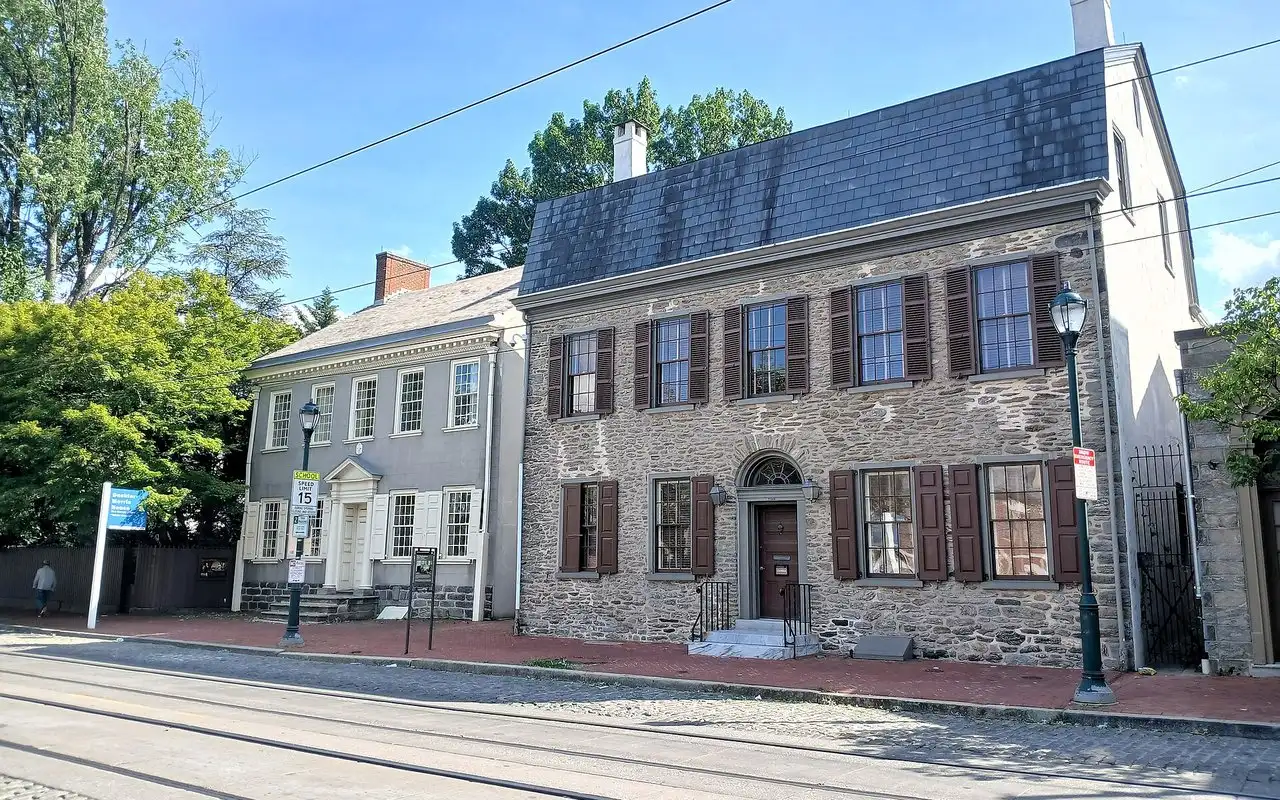
Three centuries along one avenue
Germantown Avenue follows an old Native American path northwest out of the city, and Germantown grew up along it from 1683. The colonial houses that survive carry a long history. Cliveden, built of stone in the 1760s, was fought over in the Battle of Germantown in 1777, and Washington lived at the Deshler-Morris House during the yellow fever epidemic of 1793. The first railroad in Philadelphia reached Germantown in 1832, and from about 1850 large suburban houses went up around what is now Tulpehocken station. So a single service call in 19144 might be to a house from the 1760s, the 1860s or the 1940s, each heated in a completely different way.
Heat that was added later
None of the colonial houses were designed for central heat, and the early Victorians came along while it was still new. When the Ebenezer Maxwell Mansion went up on Tulpehocken Street in 1859, its gravity hot air system was one of its modern features, along with gas lighting and running water in the kitchen. Gravity systems moved warm air through large ducts by convection alone, and many such systems were later replaced by boilers and radiators or converted to forced air. That layering is what makes older Germantown houses interesting to work on. Before recommending anything we trace what is there now, what it replaced and what still works. You get the price before the work starts.
Boilers and chimneys in the Victorian houses
The Victorian houses near Walnut Lane and Tulpehocken Street were built with masonry chimneys; the Maxwell house alone has four stone ones. A well-kept boiler and cast-iron radiators still suit houses like these. The catch comes at replacement time. A modern high-efficiency boiler vents through a plastic pipe in the wall, which can leave the water heater as the only appliance using a large, cold chimney, and that usually calls for a liner. Planning for it up front avoids a surprise on inspection day.
Historic rules and outdoor equipment
Much of Germantown Avenue sits in the Colonial Germantown Historic District, and in East Germantown the Awbury Historic District, around Awbury Arboretum, has been on the Philadelphia Register of Historic Places since 2010. For a property on the Philadelphia Register, changes to the exterior need Historical Commission approval as part of the building permit, and its reviews focus on what the public can see. That makes the back or side of the house the natural place for a condenser and its refrigerant lines.