
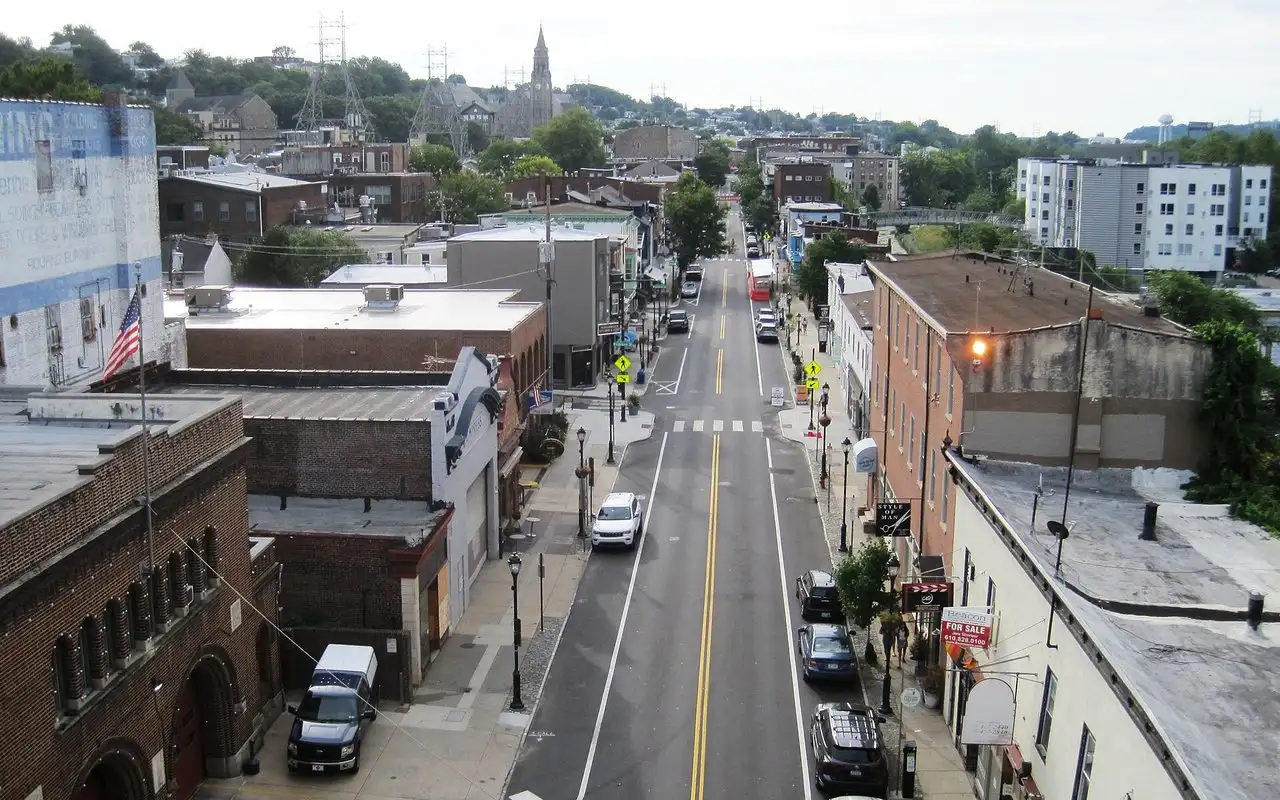
Rowhouses built for the mills
Manayunk’s houses were built for the people who worked in the mills along the canal, which the Schuylkill Navigation Company finished through here at the end of 1818. They are narrow rowhouses of two and three stories, set shoulder to shoulder on streets that rise from Main Street toward Roxborough. Houses of this age commonly heat with a gas boiler feeding radiators, or with a furnace squeezed into a small basement. When a rowhouse boiler quits, the fault is usually a single part, such as a circulator pump, a zone valve, an expansion tank or an igniter. We find it, show you what failed and give you the price before any work starts.
Steep streets and small back yards
The bike race climb up Levering Street and Lyceum Avenue, called the Manayunk Wall, reaches a 17 percent grade, and the rest of the neighborhood is known for hilly, cobbled streets. That shapes heating and cooling work more than most people expect. A new boiler or condenser may have to go up a flight of front steps or down a tight basement stair, and a heavy unit on a steep sidewalk needs a careful crew. Behind the house there is usually a small yard or a flat rear roof, and that is where the outdoor unit ends up. We plan that spot before quoting, so noise, drainage and room for service are settled first.
Cooling a mill-era rowhouse
Rowhouses from the mill era were built long before central air, and the party walls between neighbors leave little room to add ducts later. Heat collects at the top of the stairwell, so the third floor usually needs the most cooling, and it is the floor where a window unit struggles most. Since many homes here are rented, tenants and owners should agree on who arranges a new system before anyone plans one. Gas here comes from PGW, the city-owned utility, and electricity from PECO, so switching from a gas furnace to a heat pump moves part of the heating bill from one utility to the other.
Main Street, mill lofts and condos
Since the 1990s Main Street has filled with restaurants and shops. Several of the old mills along the canal have become loft apartments, and a condominium tower went up on Venice Island in 2004. In converted buildings like these, each unit often has its own heat pump or fan coil, while boilers and rooftop equipment serving everyone belong to the building. Knowing which system is yours before something breaks saves a call to the wrong person on a cold night.