
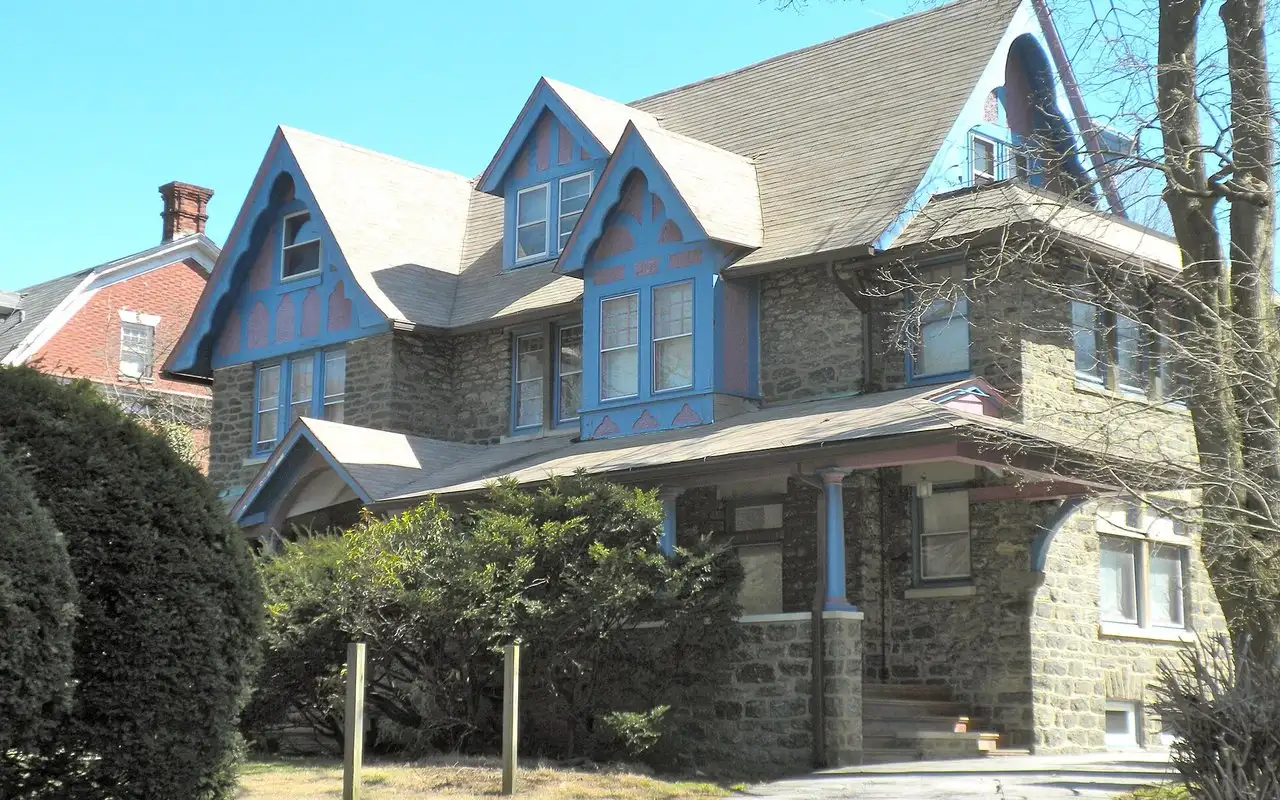
A neighborhood that shared one boiler
When Drexel & Company laid out Overbrook Farms in the 1890s, it sold the houses as a suburb with everything supplied. Water came from springs through a tower on Woodbine Avenue, electricity came from the Overbrook Electric Company and heat came from a stone steam plant built in 1893 at Upland Way and Woodbine Avenue. That plant warmed every building in the district until 1973.
Once it closed, each house needed a heat source of its own. That history is worth knowing when a boiler there acts up, because the equipment in the basement was fitted to piping and radiators laid out for a different plant. Knowing how the two were joined is the first step in deciding between a repair and a replacement, and the price comes before the work does.
Rowhouses and roomy twins
Outside Overbrook Farms the neighborhood is mostly rowhouses, built between 1915 and 1930 as the trolleys let families move out of the older, denser parts of the city. Mixed in are twins of two or three floors, many over 2,000 square feet, on streets like Wynnewood Road and Nassau Road. Detached houses are the exception here.
Each of those forms sets its own limits. A rowhouse has only its front and back to work with, so cooling equipment ends up on the rear roof or in the back yard, and the refrigerant lines have to reach it without crossing a neighbor’s wall. A twin is simpler, since each half normally has its own furnace or boiler, but a big three-floor twin still has a long way to push air to the top bedrooms.
Steam, kept or replaced
If your house still runs on steam, there is no rush to give it up. A steam system that has been looked after can keep working for a long time, and most of its complaints, like hammering pipes and radiators that stay cold at one end, have simple causes. When a steam boiler does need replacing, the new one has to be sized to the radiators it will feed, not only to the size of the house, or the far rooms go cold. Some owners use the moment to change to a different system entirely, which is a bigger project and worth pricing side by side.
Cooling a house with no ducts
Many Overbrook houses were built long before central air, so cooling is usually something added later. In a tall twin, an air handler in the attic is a common route to cooling the top floor, with its outdoor unit on the owner’s side of the lot. Overbrook is a short drive from our Bala Cynwyd shop, and we fix things the same day when we can.