
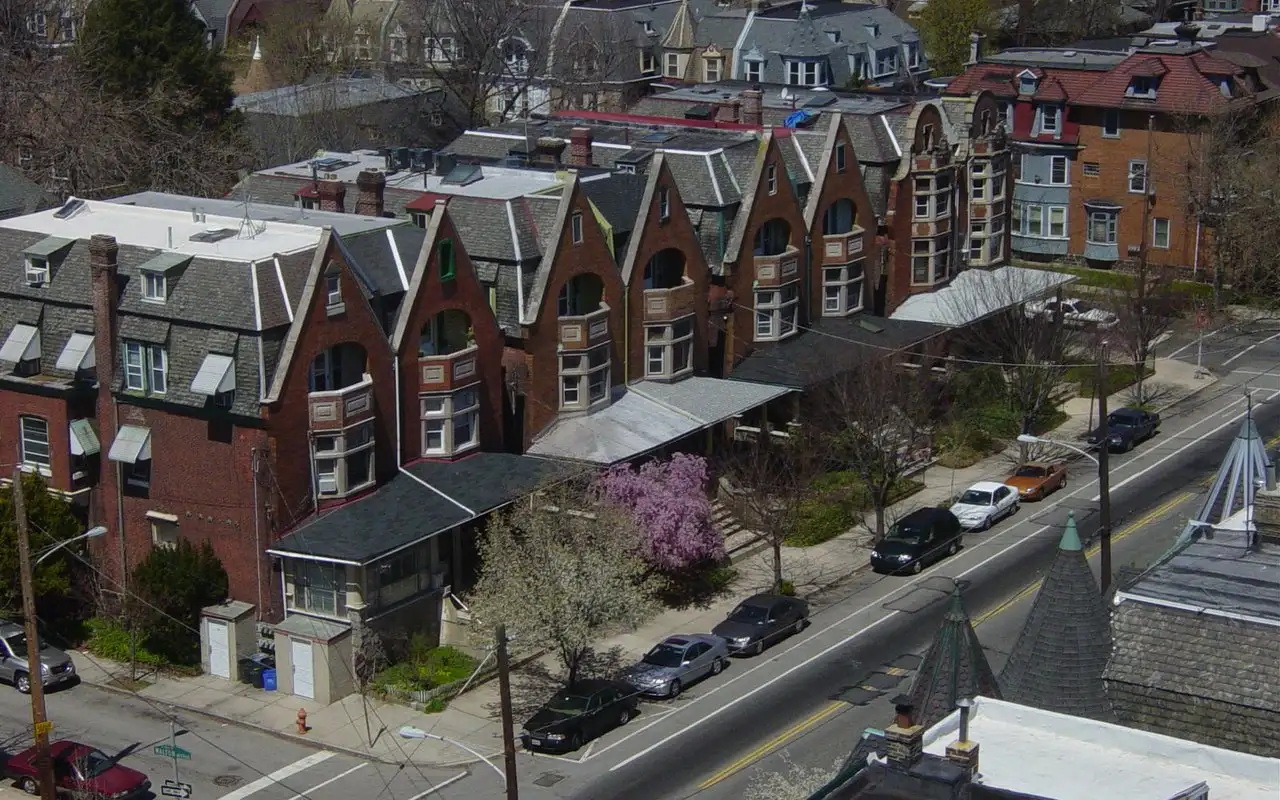
A city of rowhouses and twins
Philadelphia has a higher share of rowhouses than any other American city, about 70 percent of its homes by the most widely cited count, and roughly three quarters of them are more than fifty years old. In West Philadelphia the twentieth-century blocks are typically porch-front rows and twins, and twins also fill parts of Overbrook Farms, East Mount Airy and Chestnut Hill. A rowhouse is usually 14 to 18 feet wide with a neighbor on each side, so there’s no side yard for equipment and every pipe, duct and refrigerant line has to find its way through a narrow house. That shapes most heating and cooling decisions here, from where a new furnace sits in the basement to how an air conditioner gets its lines up to the roof.
Boilers, radiators and gas heat
Most Philadelphia homes were still heated with coal in 1940. Oil took over by 1960, and by 1970 utility gas had become the city’s main heating fuel, as it still is today. The older houses were built around a furnace or boiler in the basement, sending warm air, hot water or steam up through the house. Where that original boiler and its radiators are still in service, a problem usually comes down to one part: a circulator, a valve, an expansion tank or an igniter. We find it, show you what we found and give you the price before we start. If the boiler really is near the end, you see the replacement price next to the repair so you can decide.
Gas in the city comes from PGW, which the city owns and which is the largest municipally owned gas utility in the country. Electricity comes from PECO. That split matters when you buy equipment, since rebates on gas furnaces and boilers run through PGW’s EnergySense program while rebates on heat pumps come from PECO.
Cooling a brick rowhouse in a Philadelphia summer
Brick rowhouses bake in the summer sun and give that heat back after dark, which is why a top floor can stay warm long after sunset. The city’s health department has found that some Philadelphia neighborhoods run as much as 22°F hotter than others, with the hottest blocks where pavement and dark roofs trap heat and trees are scarce. In a house with ducts, central air is the usual route. Window units work as a stopgap, but they take up windows in a house that gets its light only from the front and back.
Where the outdoor unit goes
On a narrow lot the condenser has three possible homes: the rear yard, the flat roof or, on a twin, the side yard, and each has trade-offs. A roof unit needs a solid stand, a safe way up for service and a line set routed down through the house. A yard unit needs room to breathe and some distance from a neighbor’s bedroom window. We plan the location before we quote, not after.
From Center City to the stadiums
Center City, Fairmount, Northern Liberties, Fishtown and South Philadelphia down to the stadiums are the heart of our work in the city. Our shop is in Bala Cynwyd, about 15 minutes from City Hall and Fairmount and about 20 from Fishtown and the sports complex before traffic. Wynnefield, Overbrook and Manayunk are closer still, a few minutes across City Avenue and the river. That helps when the heat goes out on a January night or the air conditioning quits in July. We make same-day repairs when we can and answer emergencies around the clock.